Do Horses Feel Empathy?
If you’ve ever asked, “Do horses feel empathy?” online, you’ve probably met this comment: “Stop anthropomorphizing.” And sure — I understand the caution. Humans can project motives where we don’t have proof, and horses don’t think in words the way we do. They aren’t building moral arguments in their heads. They aren’t writing explanations for why they did what they did.
But there’s also a truth I can’t unsee, no matter how careful I try to be with language: horses respond to the emotional states of others. Sometimes they respond by leaving. Sometimes they respond by watching. Sometimes they respond by stepping in. And sometimes they do something so quietly protective that it changes the way you understand them forever.
Part of the argument comes down to the word itself. “Empathy” is a human term, and it carries a lot of baggage — intention, compassion, self-awareness, even the idea of choosing to care. When people object to anthropomorphizing, I think what they really mean is, “Don’t claim you know the horse’s inner monologue.”
That’s fair. We can’t climb inside their minds. But we can watch what they do. We can notice patterns. We can describe behavior honestly. And we can admit that the behavior sometimes looks like a horse perceiving distress and responding to it in a way that reduces pressure, protects the vulnerable, or steadies the emotional temperature of the group.
If it helps to make this less loaded, I like to think of empathy as a ladder. At the lower rungs you have emotional attunement — the ability to notice another’s state. Then emotional contagion — where one nervous system begins to match another. And higher up, you have prosocial response — something that looks like support, protection, or intervention. Research can measure parts of this ladder more easily than others: heart rate, posture, approach-and-avoid patterns, stress behaviors.
What’s harder to measure is “why.” That’s where humans tend to start arguing. But the “why” isn’t the only thing that matters. Because sometimes a horse does something so specific, so timely, and so out of character for their level of trust… that you’re left with a simple, stubborn observation: they noticed. And they responded.
Floki and the Windbreak
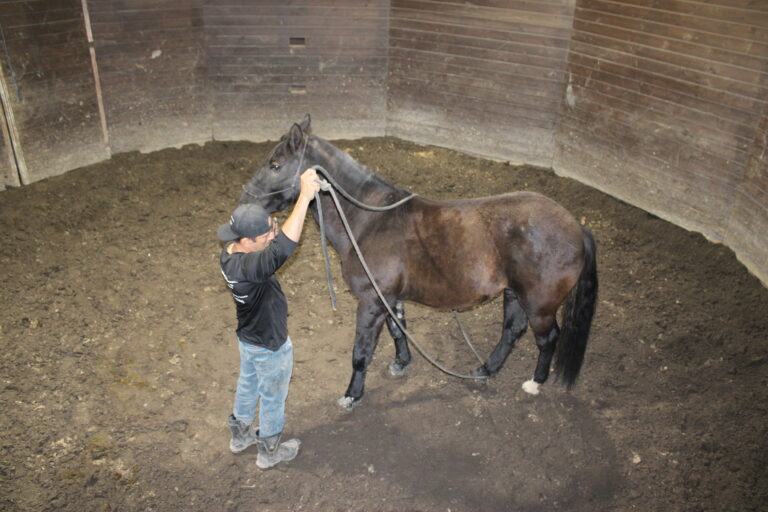
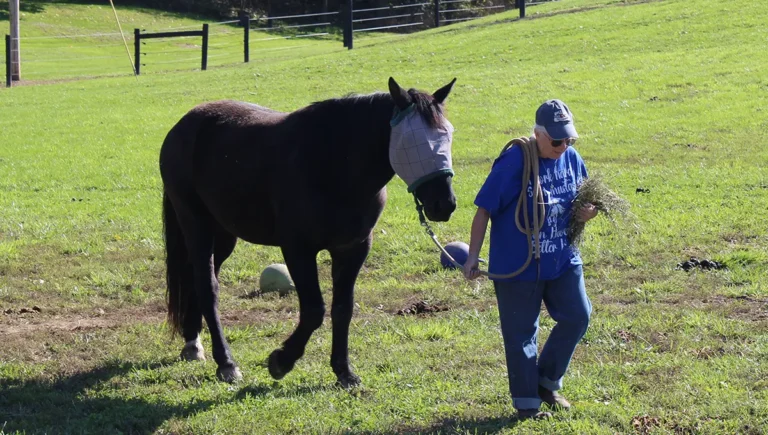
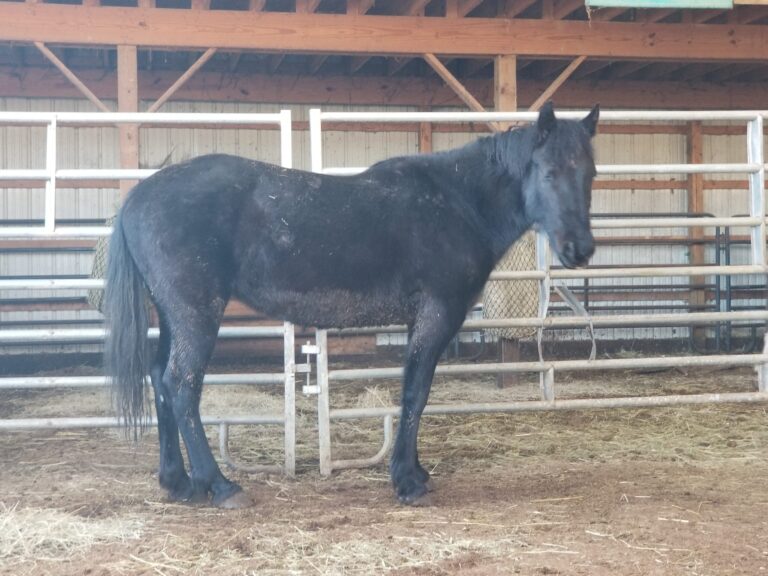
Two weeks into Floki’s gentling, it didn’t feel like much of a relationship yet. It felt like standing in the cold and trying to be patient while this black, wild-eyed gelding watched me like I was a stalking wolf. He was still afraid of me. He didn’t want to be caught; he didn’t want to be touched. The idea of me laying a hand on him was still too much.
That day was bitter cold — the kind of wind that slices straight through your sweater and rattles your bones. I was shaking so hard every muscle was locking up with the effort to keep me from freezing. Teeth chattering, whole-body shivering, that uncontrollable kind that makes you feel a little ridiculous and a little desperate, like maybe you should call it a day and retreat to the warmth of the car.
Floki watched me for a long time. Not casually. Intently. Then, as the wind picked up, he did something new.
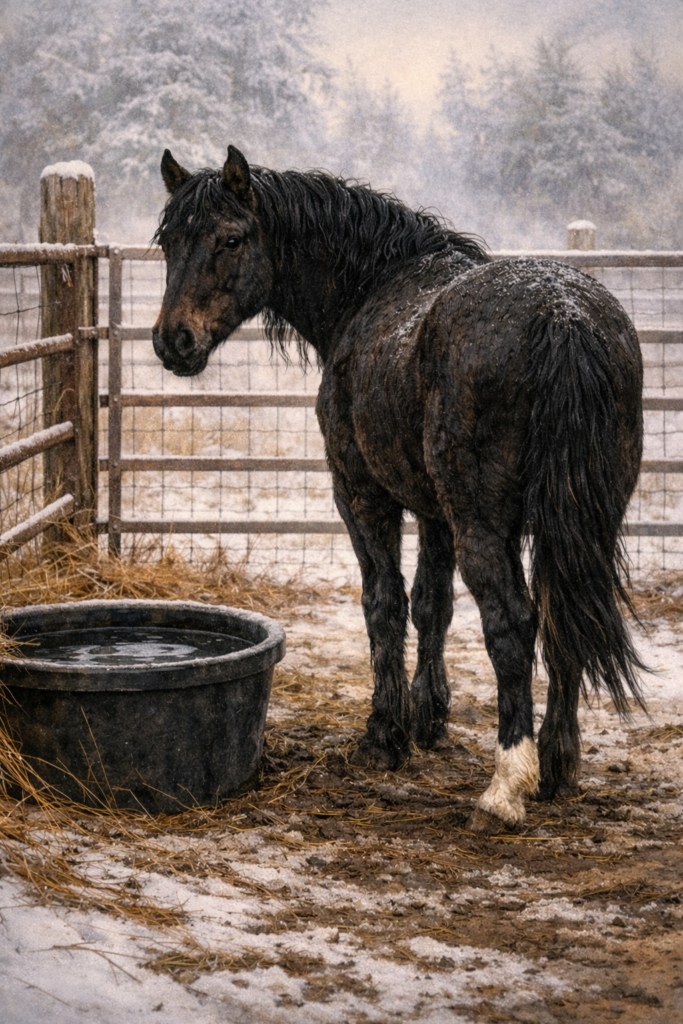
He drifted closer. Not close enough to touch — he kept that careful bubble of space between us — but close enough that his body took the brunt of the wind. Close enough that the air quieted a little on my side of him. He stood there still tense, still ready to move if I did something wrong… but he stayed.
I can’t prove what he thought. I can’t claim it was a big cinematic moment of instant bond. It wasn’t. There was no first touch, no magical click where everything changed. It was smaller than that, and because it was smaller, it felt even more true. It felt like a scared mustang saying, I can’t let you all the way in yet… but I see you. And I’ll stand with you in the wind. (To read more, check out The Heart Horse I Almost Sent Back.)
If someone wants to call that coincidence, they can. But if you’ve spent time around horses — especially horses who are still protecting their distance — you learn what “random” looks like. You also learn what choice looks like. And whatever label we put on it, that moment was a choice.
The Mare Who Stepped in for the Filly
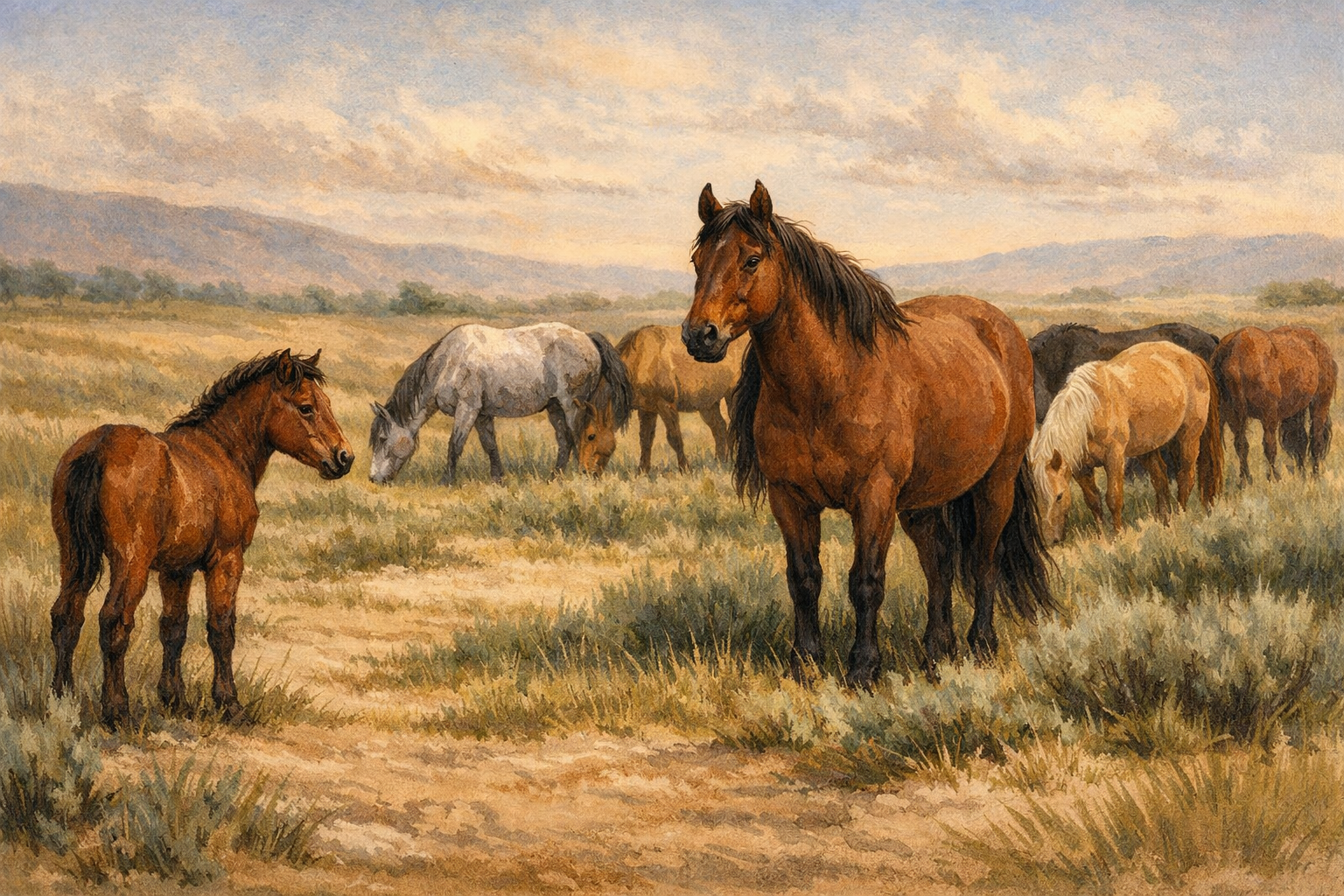
Years ago, I heard a story from someone observing wild horses from a distance, the way you do when you want them to act natural. A yearling colt was relentlessly picking on a much younger filly, and the filly couldn’t get away. The rest of the horses seemed to be ignoring it, grazing as if it wasn’t their problem. Then one mare changed the entire situation.
She didn’t charge in. She didn’t make a spectacle. She simply began to drift — slow, casual, unhurried — working her way around the band in a wide arc. When she finally came close, it was from an angle the colt didn’t notice until it was too late. She disciplined him sharply with a bite to the rump, and then she went right back to grazing as if nothing happened. But the lesson didn’t end with that bite.
For the next couple of hours, that mare kept herself positioned between the colt and the rest of the herd, quietly controlling access. Teaching him that harassment would cost him something. Teaching him that the herd had boundaries, and that the vulnerable weren’t fair game just because they were smaller. Eventually she stopped placing herself in that blocking position and the colt was allowed to rejoin normally.
Was that empathy? Maybe. Or maybe it was herd stability. Maybe it was social order. Maybe it was a mare reading the pressure in the group and lowering it the only way horses do — with timing, space, and consequence.
But here’s what sticks with me: she noticed distress, intervened, and then maintained the boundary until the pressure stopped. If we refuse to recognize any emotional intelligence in that, we end up pretending horses are far simpler than they are.
What Science Supports
This is where I like to keep my feet on the ground. We don’t need to claim horses are somehow human or have human emotions in order to respect what they’re capable of. We can simply acknowledge what research increasingly supports: horses are socially aware, emotionally responsive animals, and they are sensitive to the cues of the beings around them — often in ways that put most of us to shame. For example, research has shown horses can distinguish between angry and happy human facial expressions.
A horse notices the smallest shifts: a held breath, a tightened jaw, a change in your weight, the angle of a shoulder, the energy in a group. They read bodies the way we read sentences. And because they’re prey animals built to survive by detecting change early, they don’t have the luxury of being socially “checked out.” They’re constantly tracking the emotional weather around them — not for drama, but for safety. Other studies suggest they can even discriminate human emotional states through scent.
And maybe that’s the simplest way to defuse the argument about the word empathy. Empathy is just a label we use for something we can actually see: noticing another’s emotional state and responding in a way that fits. Not necessarily “feeling sorry,” not a human-style moral decision — just perception and an appropriate response.
By that definition, it’s hard to argue horses don’t have it. To say a horse can’t see and respond to their handler’s emotion is simply not accurate. Anyone who has watched a horse soften when you soften, brace when you brace, or become cautious when your confidence wavers has already witnessed it. You don’t have to turn horses into people to admit they’re reading us — and adjusting — all the time.
A Few Ways Empathy Shows Up in Horse Language
Sometimes the most convincing examples aren’t dramatic at all. They’re quiet. A calm horse positions themselves near an anxious herd mate, not crowding — just present. Sometimes they choose the exposed side, the side facing the pressure, as if absorbing a little of it. A higher-status horse intervenes when another is being harassed — not always with fireworks, often with simple movement and controlled space that changes the entire outcome. A worried horse exhales when their buddy arrives, their posture loosens, their feet stop dancing. People will argue about what to call that, but the regulation is real.
And many of us have seen horses approach a crying person differently than they approach a laughing one — not because the horse understands the story, but because the horse understands the state.
So… Do Horses Feel Empathy?
Here’s my most honest answer: Horses experience emotion. They perceive emotion in others. They respond to it. Sometimes those responses reduce distress or protect a vulnerable individual. If someone wants to argue that we shouldn’t call that “empathy,” fine. We can call it emotional attunement. We can call it social buffering. We can call it concern behavior, or sensitivity, or emotional intelligence, or herd-mindedness. But the behavior doesn’t disappear just because we swap the word. And I would rather be careful and truthful than “safe” in a way that shrinks them into something they’re not.
Because the moment we decide horses can’t feel, we stop listening. And the moment we stop listening, we get dangerous — not just for us, but for them.
Share Your Story
I’d love to hear your story about your horse. Have you ever had a moment where your horse seemed to notice your emotional state — fear, grief, stress, exhaustion, joy — and respond in a way that felt like attunement, connection… maybe even empathy? Maybe it was something big and unmistakable. Maybe it was something small: a step closer, a softer eye, a quiet presence, a boundary held on your behalf.
If you’re willing, share it in the comments. Tell me what happened, what you noticed in their body language, and what it changed for you. I read every story, and I have a feeling we’re not the only ones who’ve been “stood with” in the wind.
One Comment