When Mustangs Accept Us as Part of the Herd
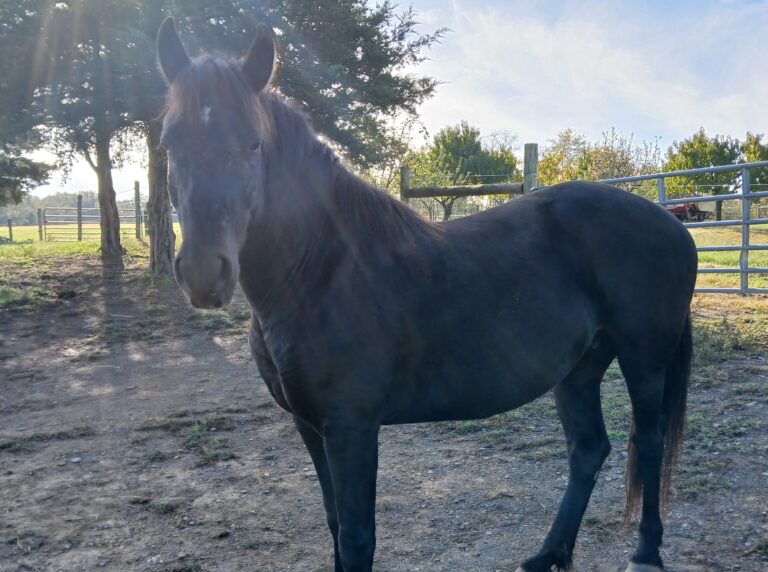
When mustangs accept us as part of the herd, it can show up in ways that are quiet, powerful, and hard to forget. When I wrote Has Your Mustang Ever Tried to Protect You, about Floki trying to save me from a raincoat he was convinced might be swallowing me whole, I thought I was sharing one odd, funny, deeply personal story. Instead, it opened the door to a flood of stories from other people whose horses, mustangs and otherwise, had also shown them moments that felt like something more than simple reaction. It felt, again and again, like inclusion.
The comments filled with stories from people whose mustangs had done something similar. They stood between their humans and danger. They stayed with injured people. They guarded children. They drove off dogs, bears, other horses, and strangers. They checked in by touch. They stayed close even when they were scared themselves.
The details were different, but the feeling underneath them was not. Again and again, the stories seemed to circle back to the same quiet truth. At some point, these horses were doing more than reacting. More than simply being alert. More than moving through a trained response. They were taking their humans into account.
That is the part that has stayed with me, because I don’t think moments like that are always easy to explain from the outside. Sometimes a horse’s behavior probably is just caution, tension, instinct, or coincidence. Horses are still horses, and not every meaningful moment needs to be stretched into something larger than it is.
But when the same themes rise over and over, across so many people and so many horses, I think it is worth pausing to listen. What I kept hearing in those stories was belonging. Not ownership. Not obedience. Not affection performed in a way humans happen to like. Belonging. The kind of belonging that happens when a mustang begins to accept us as part of his circle of concern.
That is not a small thing. For mustangs, herd life is not decorative. It is not sentimental. It is survival. It shapes who stays close, who watches whom, who warns, who follows, who trusts, and who gets counted in the quiet math of safety. So when a mustang begins to act as if your safety matters to him, I think that means something. Maybe not in a neat, tidy, provable sentence. But in the lived language of horses, it means something. It may mean that, somewhere in his mind, you are no longer moving through his world as an outsider. You are being counted as part of his herd.
That thought kept returning to me as I read the stories people shared. Horses who put themselves between their person and what scared them. Horses who stayed when they could have fled. Horses who came back to check on someone who had fallen. Horses who touched, hovered, guarded, blocked, waited, and watched. Those are not all the same behavior, and they probably do not all come from exactly the same motive. But taken together, they suggest a shift that feels deeper than simple training. They suggest inclusion.
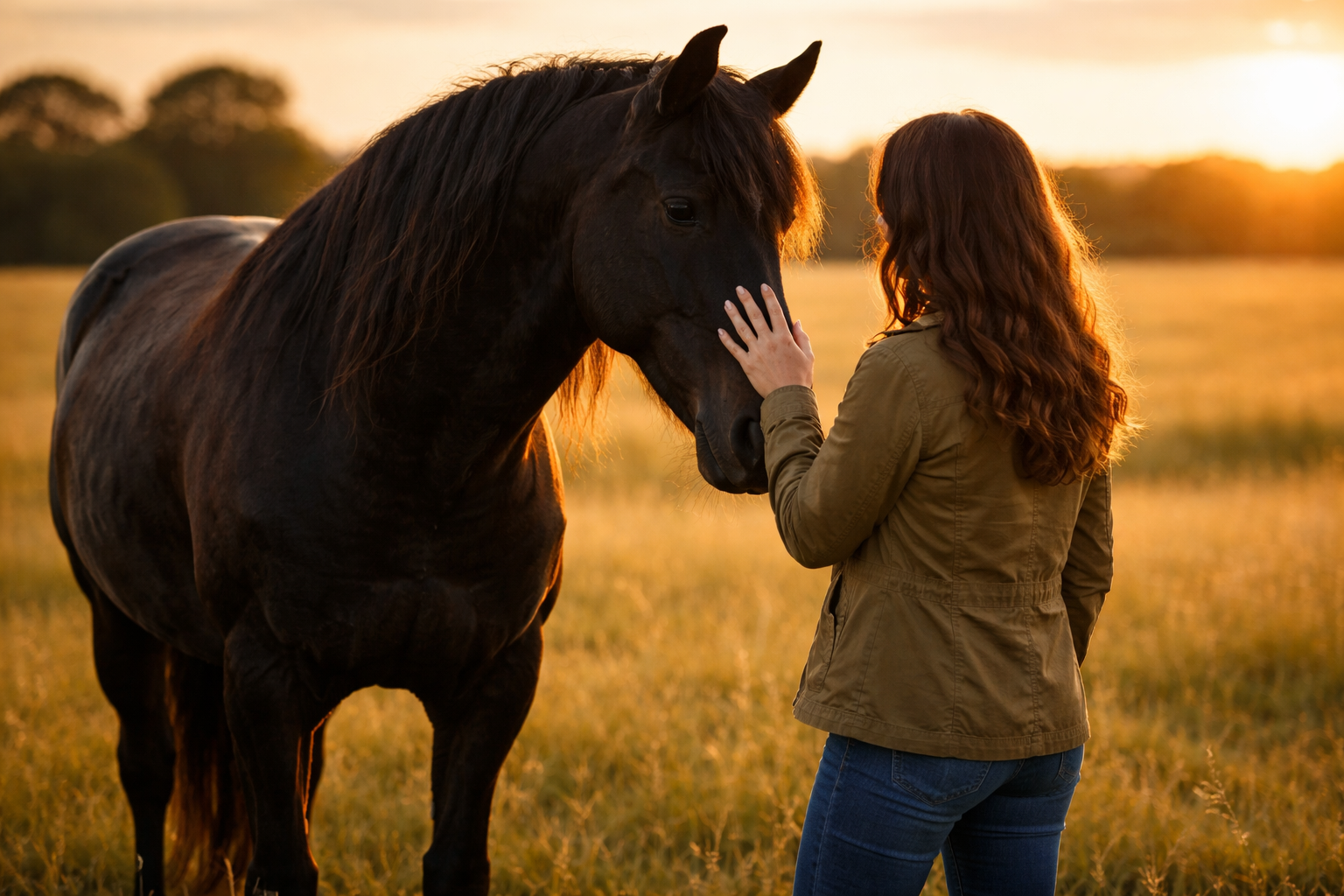
I think that may be part of why these moments land so hard in the hearts of the people who experience them. Most of us know the difference between a horse tolerating us and a horse truly taking us into account. We know the difference between being handled and being included.
A horse can learn our cues without feeling deeply connected to us. A horse can stand quietly, follow pressure, perform well, and still hold himself apart. There is nothing wrong with that. Horses do not owe us intimacy just because we feed them, ride them, or love them. But when a horse begins to watch over us in some small, voluntary way, it feels different. Not because it makes us important, but because it makes us feel included.
That is the word I keep coming back to. Included. Not above them. Not in control of their inner world. Not magically transformed into horses ourselves. Just accepted enough that, in a moment that matters, they respond as if our well-being belongs inside the boundary of what they care about.
I think that is one of the deepest gifts a mustang can offer, and I think it matters even more because it cannot be demanded. You cannot bully a horse into true inclusion. You cannot pressure him into sincere concern. You cannot force belonging out of fear, dominance, or performance. You can create compliance that way. You can create shutdown. You can create habits. But you cannot manufacture that quiet moment when a horse chooses, on his own, to account for you.
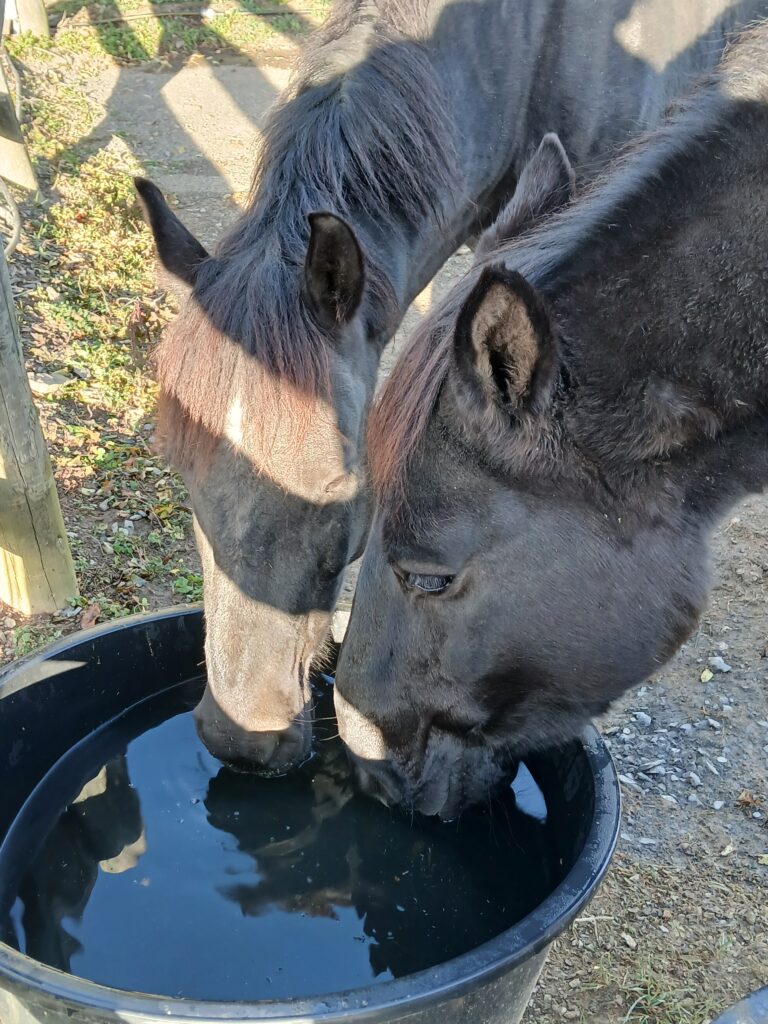
That part has to be given, and maybe that is why it means so much when it happens. With Floki and Lagertha, I feel that belonging deeply. They aren’t just beloved horses. Not just heart horses. They’re my soul mates.
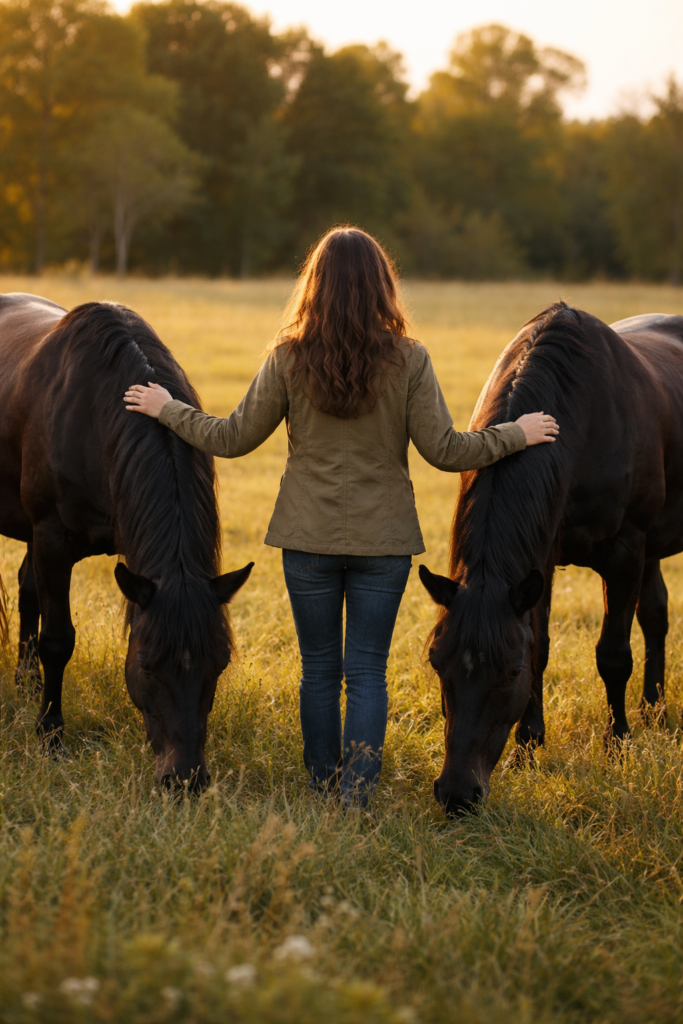
I know that phrase will not mean the same thing to everyone, and that is all right. I am not using it lightly, and I am not using it for effect. I mean it in the truest way I know how. Some bonds grow out of admiration. Some grow out of responsibility. Some grow out of time. And then there are bonds that feel like recognition.
That is what these horses are to me. Not because they are perfect. Not because every moment has been easy. Not because I imagine things that are not there. But because over time, through fear and patience and listening and repair and all the quiet moments that would look like nothing to most people, something deeper took shape. Something that feels less like ownership and more like mutual knowing.; less like control and more like being allowed in.
I think that is part of why protective moments can feel so powerful to people who have lived them. On the surface, the story may be about a horse stepping between you and danger, or staying with you when you are hurt, or touching you as if to check whether you are all right. But underneath that moment is another question entirely. Do I belong to this horse in some meaningful way? Not as property. Not as a project. Not as the source of feed or comfort. As someone he has chosen to count.
For those of us who have felt that shift, even once, it is very hard to explain to people who have not. The moment itself may look small from the outside. A horse moves closer instead of away. A muzzle touches your shoulder or cheek. A body positions itself between you and what feels wrong. A frightened horse stays when leaving would have been easier. None of that may look dramatic to anyone else, but from the inside, it can feel enormous. It feels like being answered.
I do not think every mustang expresses this in the same way. I do not think every protective-looking behavior means the same thing. And I do not think humans should rush to turn every horse response into a flattering story about ourselves. But I do think belonging leaves traces. I think inclusion shows up in behavior. I think horses tell us, in quiet and practical ways, who they are willing to keep near, who they worry over, who they return to, and who they make room for inside their sense of safety.
That may be especially true for mustangs, because so much of their lives has been shaped by the real stakes of herd living. Their bonds are not abstract. Their awareness is not abstract. Their decisions about distance, attention, and concern come from somewhere old and deeply rooted. So when a mustang begins to treat a human as someone worth checking, shielding, or staying with, I don’t think that is nothing. I think it may be one of the clearest outward signs that the human has been accepted as part of the herd.
And maybe that is why so many people responded so strongly to those stories. Beneath all the details, they were circling the same truth. At some point, a horse who did not have to care began to care. At some point, a horse who could have remained separate allowed a human closer than function required. At some point, the boundary shifted. Once you have felt that, you do not really forget it. It changes how you understand trust. It changes how you understand love. It changes how you understand the quiet, wordless ways horses tell the truth.
That is what I kept hearing in your stories. Not just protection. Not just bravery. Not just unusual behavior. Belonging.
And I think that may be one of the most beautiful things a mustang can ever give us.
If you’d like to read more about herd behavior and belonging, please check out Basics of Equine Behavior.