The Moment Trust Is Broken: A Trap Isn’t Training
There’s a video making the rounds right now that I can’t shake. A woman stands with a horse on a lead rope. A pan of feed sits on the ground a few feet ahead. She backs toward it a couple of steps with the horse following, then shifts her body and “opens a path” like an invitation: go ahead. The horse hesitates, then steps forward and takes a bite. After a delayed beat, she starts whipping him. Not a quick correction. Not a split-second boundary. A vicious, escalating beating. This is the moment trust is broken.
The Moment Trust is Broken
The internet response has been predictable. A lot of people are reaching for a softer explanation: she doesn’t know better, education is the answer, do better when you know better. Sometimes that’s true. A lot of harm comes from ignorance, bad traditions, and people repeating what they were taught without ever questioning it. But this isn’t one of those times, because this wasn’t “bad timing” or a clumsy attempt at leadership. It was a setup. If you lure a horse into an action and then punish him for doing that exact action, that isn’t a training error. It’s coercion. It’s bait-and-switch. It’s a trap.
The reason it matters is simple: the horse wasn’t being corrected for a dangerous behavior happening in the moment. He wasn’t pushing into her space, striking, charging, or escalating pressure. He wasn’t even being rude. He was doing exactly what she invited him to do. When you hand a creature an “answer” and then beat him for giving it, you’re not teaching manners. You’re teaching hypervigilance, distrust, and learned helplessness. You’re teaching the most corrosive lesson of all: there is no safe choice. Even the right choice can get you hurt.
What This Does to a Horse’s Nervous System
The Whole Horse Journey wrote a thoughtful breakdown of what happens inside the horse’s nervous system in a moment like this: the sympathetic surge, the autonomic conflict between moving toward a primary survival resource and defending from an immediate threat, the classical conditioning that ties human proximity, food, and pain together, and the physiological aftermath that continues long after the clip ends. That’s what people underestimate. The beating doesn’t end when the video ends. A prey animal doesn’t file this away as “an unfortunate incident.” He stores it as a survival lesson. (View the original Facebook post by The Whole Horse Journey here.)
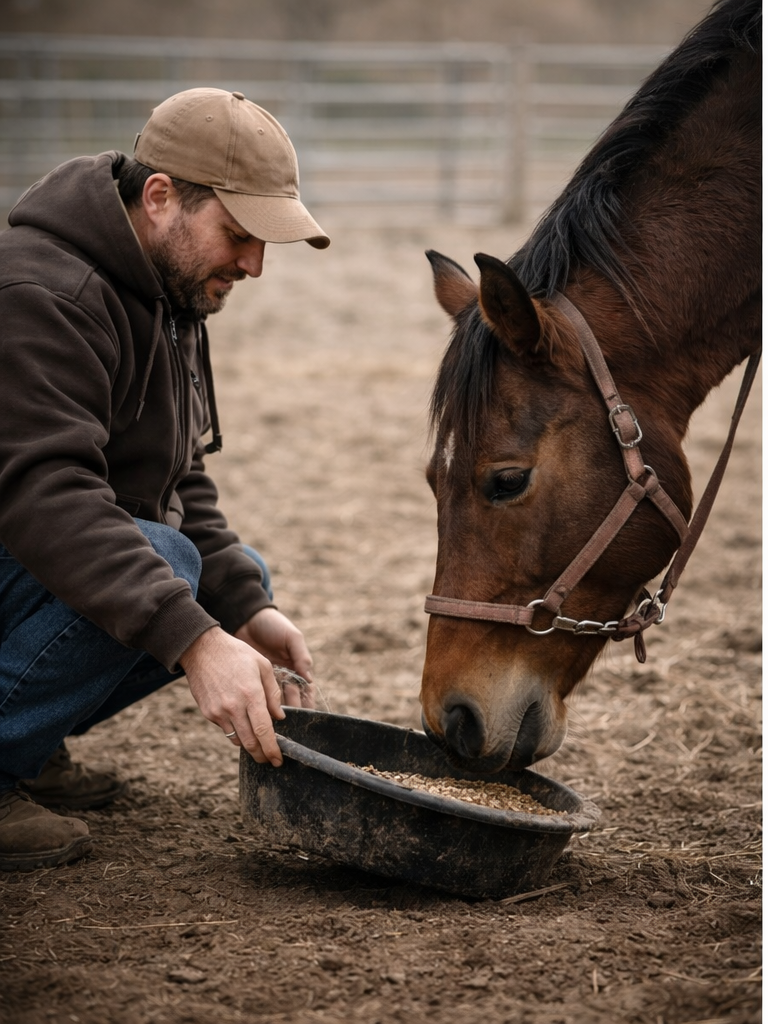
Pair pain with eating and you can turn food into something charged with danger. Food is not a “bonus” to a horse. It is survival. When fear and pain get paired with a bucket, a pan, or a human standing nearby, some horses start snatching and bolting because feeding time feels urgent and unsafe. Some begin guarding the bucket or pinning their ears when a person approaches, not because they are “mean,” but because their nervous system has learned that proximity can predict threat. Others go the opposite direction and become quieter and less expressive, and that can look like “good behavior” to an untrained eye. From a nervous-system perspective, though, that quiet can be shutdown, not relaxation. Either way, the horse isn’t learning clarity. He’s learning that even a basic need can come with consequences.
This kind of setup also teaches something even more destabilizing than harshness: unpredictability. A strict person with consistent boundaries can still be read, and a horse can adapt to predictability. But when the pattern becomes invitation, compliance, and then punishment, the horse stops believing in signals. He stops believing in safety. He stops believing the world makes sense. That’s how you get horses who look calm until they explode, or horses who look “well behaved” but live braced inside their bodies. It also punishes expression out of them.
Hesitation is communication. Careful steps forward are communication. A horse trying to be brave is communication. When a horse gets beaten anyway, the lesson becomes: don’t show your thoughts, don’t show your feelings, don’t try. Some horses externalize that and become more reactive and defensive around food; others internalize it and go dull, frozen, compliant. The second version is the one people mistakenly praise, when what they’re often seeing isn’t learning at all. It’s surrender.
Boundaries vs Brutality
None of that means horses don’t need boundaries. Horses are powerful, and they can crowd you, lean on you, bite, strike, and run right over you if the relationship has no clarity. There are absolutely moments where a handler needs to push back for safety. But real boundaries don’t look like luring an animal into a “gotcha” moment. Real boundaries happen in the moment, attached to the behavior that actually occurred, and they end the instant the horse yields.
If a horse enters your space with pressure, you raise your energy, claim your bubble, ask for a yield, and release pressure the moment you get it. Everyone exhales. That’s communication. That’s fair. And if someone doesn’t know how to do that well, the ethical answer is to learn, get help, change the environment, and manage the situation safely — not manufacture a reason to hit.
Accountability Without Mob Justice
I’m careful with viral videos, and here’s why. Not long ago, a handler’s life was nearly destroyed by edited clips that showed only the moment she defended herself, not the attack that led to it. People circulated those snippets to shut down her mustang-rescue work, and from what later came out, the fallout got so severe she came frighteningly close to suicide. Eventually, after a long stretch of legal battles and support from reputable horse people who knew her and the full story, she was able to clear her name — but the damage was real, and it was needless. So no, I’m not interested in a witch-hunt, and I’m not interested in judging anyone based on chopped footage that might be missing the most important ten seconds.
But this video isn’t that kind of situation. It was shared by the handler herself, and what we see is enough to evaluate the ethics without inventing a hidden backstory. The sequence is clear: she leads the horse toward a pan of feed, opens a path as an invitation, allows him to take a hesitant bite, and then strikes him after a delay with escalating force. That isn’t self-defense. That isn’t an immediate boundary correction tied to a dangerous action in the moment. That is setting a trap — and the trap itself is the harm.
And if you feel the urge to “do something,” do it in a way that protects horses without feeding harassment. Don’t threaten, don’t doxx, don’t go after someone’s family, and don’t make yourself the enforcement arm of the internet. Share education. Support ethical trainers. Document concerns responsibly. Report abuse through appropriate local channels when warranted, and keep your responses factual and responsible. Use your dollars and your platform to reward humane handling and withdraw support from cruelty. Accountability should be real — and it should be responsible.
We can reject mob justice and still say this plainly: baiting a horse into compliance and then beating him for it is cruelty, not training. This isn’t misunderstanding. This is a betrayal. I’m not writing this to win an argument. I’m writing it because the horse pays the price when we call a trap “training.”
You’ll hear the old line, too: “But horses need discipline.” No. Horses need clarity. Discipline isn’t violence, and it isn’t a person getting emotional and unloading on an animal because they can. If a person cannot control themselves around a horse, they have no business holding a lead rope. If someone uses food to bait a horse into a moment they plan to punish, they aren’t building manners. They’re building fear, and then they’ll blame the fear they created by calling the horse pushy, aggressive, disrespectful. A horse like that isn’t “bad.” He’s responding to a world where humans are dangerous.
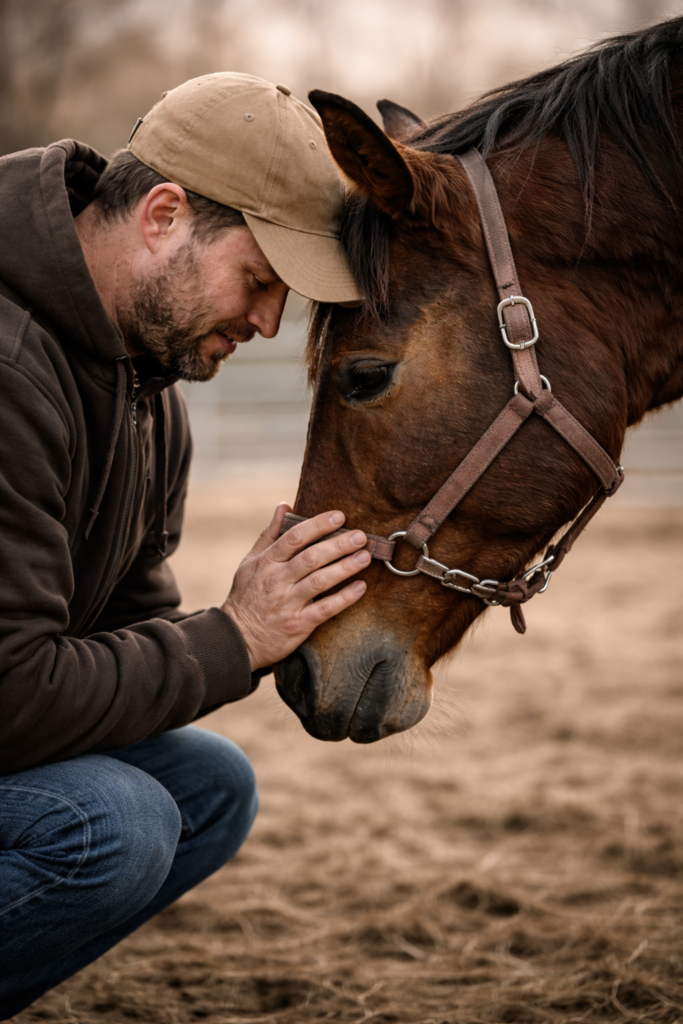
Trust isn’t sentimental. It’s biological. It’s a horse lowering their head, softening their eyes, blinking slow, sighing, chewing in rhythm, choosing to stay when they could leave, taking food without flinching, allowing a human nearby without bracing. When a human turns feeding into an ambush, those signals disappear, not because the horse is stubborn, but because he’s protecting himself. And once a horse learns a human can invite him forward and then hurt him for it, rebuilding trust is not just “do some groundwork.” It can take months or years of repairing associations at the nervous-system level. That’s a massive theft, and it was completely preventable.
So here’s the hard truth: a person who deliberately lures a horse into an action just to punish that action is not “uneducated.” They are unsafe. And a person who is unsafe is not safe to handle horses, because the animal is trapped in their power. A horse can’t file a report. A horse can’t leave. A horse can’t explain themselves. They can only endure, defend, or shut down.
If someone watching this genuinely wants to do better, the starting point is not complicated. Stop using food as a trap. Food can be a relationship builder when used ethically, and a betrayal when used to bait punishment. If you need space, teach space honestly: ask for a yield, release when you get it, repeat until it becomes a habit. If your horse crowds you, address it in the moment with clear pressure-and-release, not delayed violence. If you feel anger rising, step away and put the horse away, because a dysregulated human should not “train” a prey animal. And if you believe fear creates respect, understand this: fear creates compliance, but it destroys trust, and trust is what keeps you safe long-term.
This isn’t about nitpicking a method or arguing training styles. It’s about betrayal. The horse in that video did the brave thing: he tried. He followed an invitation. He took the risk. And he got punished for believing a human. That is the kind of moment horses remember with their whole bodies, and it’s why some horses spend years flinching at buckets, guarding food, snapping when hands reach toward them, or going quiet in ways that get misread as “good.” If you care about horses, don’t defend traps. Name them. Because the only thing worse than cruelty is cruelty with a crowd making excuses for it.
The Quiet Miles
Listening for the horse beneath the behavior.
To read more about building trust with horses in general, and mustangs in particular, see Floki’s Trust. And if you’d like a practical example of boundaries without betrayal, read Floki’s No.