Why People Love Mustangs: The Wild Kind of Trust
Floki didn’t have to choose me. But he did—and that changed everything.
Why people love mustangs: because when a wild horse chooses you—really chooses you—it feels like belonging.
There’s a kind of closeness you can earn with most horses—through time, consistency, good hands, and the steady comfort of being a familiar part of their world. Horses are generous that way. They meet us where we are, and they forgive our clumsiness while we learn.
But a mustang adds something extra to that equation.
Because a mustang begins with distance.
A mustang begins with the ancient, sensible assumption that humans are trouble—predators in soft clothing, pressure with a heartbeat. A mustang doesn’t need us. Doesn’t require us. Doesn’t have to let us near, doesn’t have to soften, doesn’t have to choose anything but survival.
And yet.
Sometimes one of them turns their face toward you and decides that you are not only safe, but worth letting in.
That’s the part that’s hard to explain to anyone who hasn’t felt it. It isn’t just “my horse likes me.” It’s deeper than affection. It’s the meeting of two souls where one of them has every reason to remain guarded—and chooses closeness anyway.
If you’re feeling that pull and wondering where to start, here’s the practical doorway: the BLM’s step-by-step guide on how to adopt or purchase a wild horse or burro.
The wild “yes” that changes everything
Mustang love doesn’t arrive with fireworks. It arrives like a door unlatched—slowly, quietly, one honest moment at a time.
And for me, one of those moments had a sound.
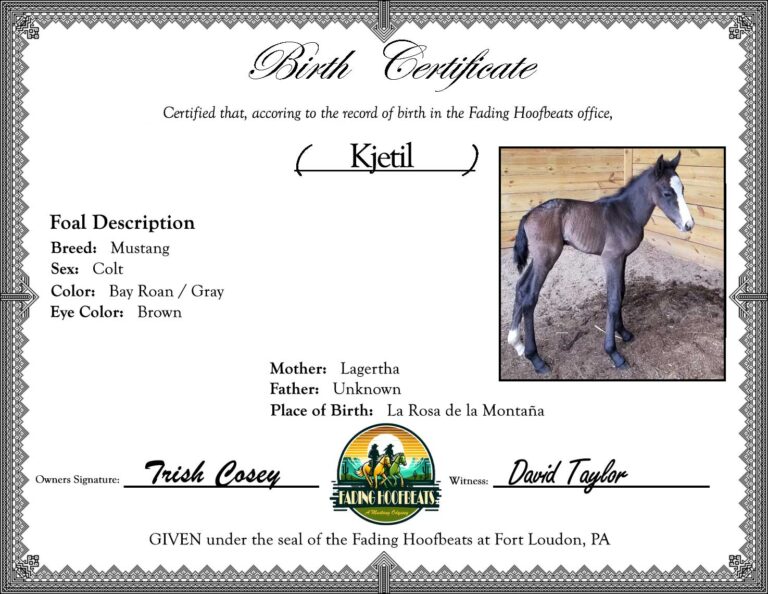
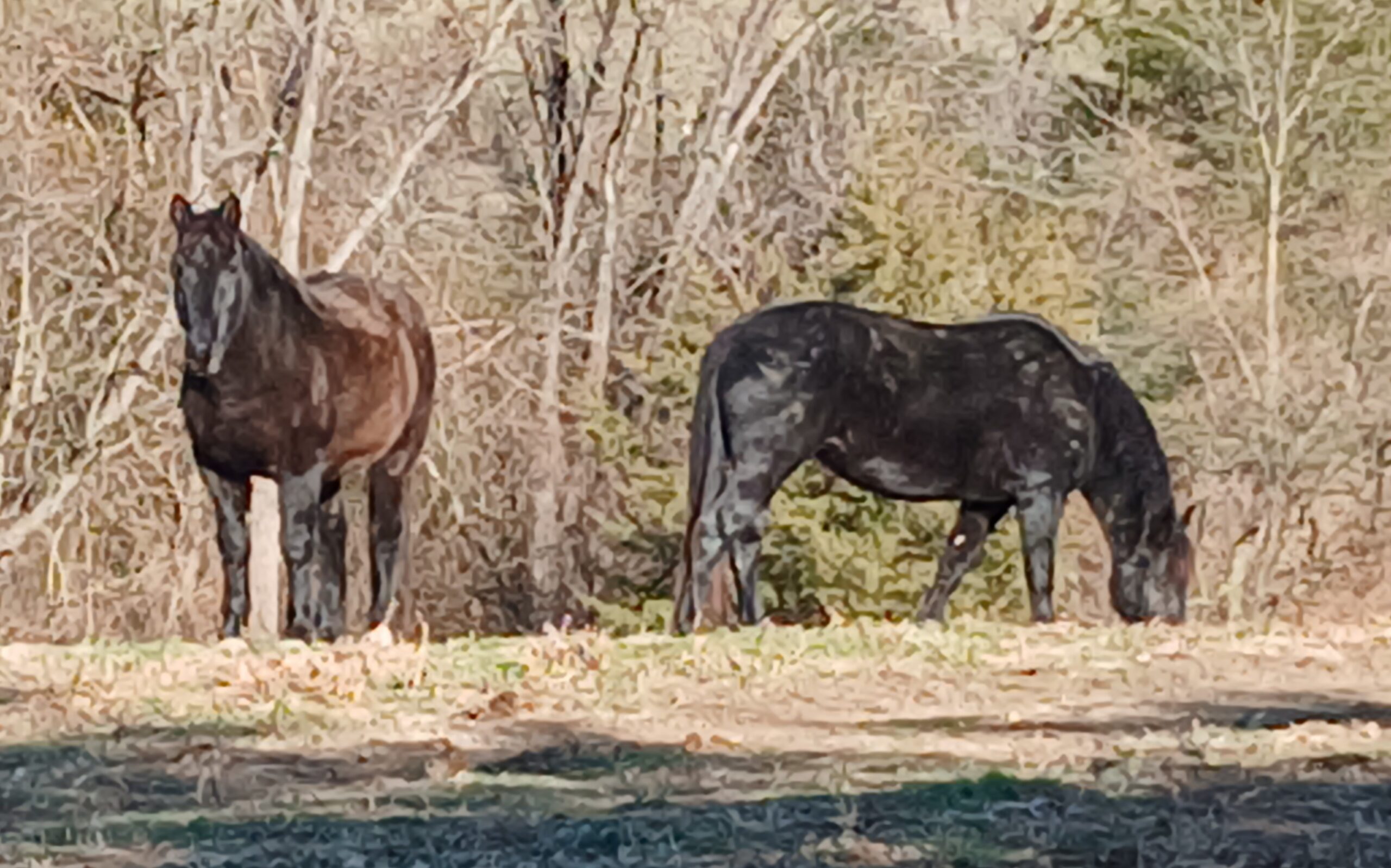
Back when Floki and Lagertha were boarded at the barn, I had a small ritual: I always fed my horses first. I wanted them to know they mattered to me—mine before the rest of the shedrow. And because Lagertha was supposed to be my heart horse, I fed her first.
She understood the routine. The moment I opened the gate and stepped into the shedrow, she’d give me one confident nicker—then wait, like a queen certain of her place.
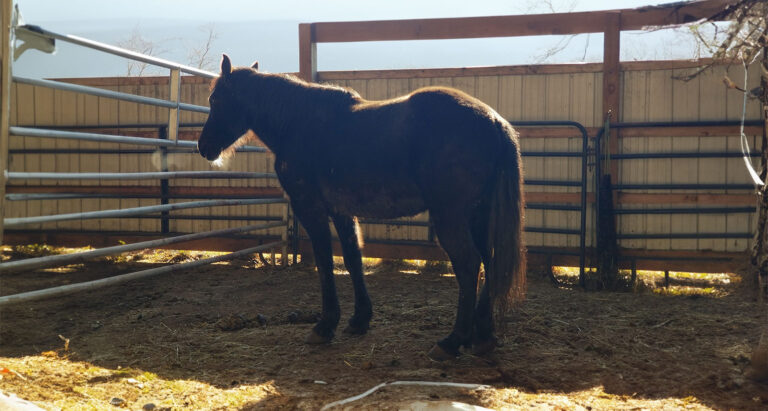
Floki, though, would stand silent and still, watching, always waiting his turn.
Until one day he didn’t.
I was passing his stall on my way to Lagertha when I heard Lagertha’s nicker right on cue—and beneath it, almost simultaneously, a second sound: softer, lower, tentative. It took me a beat to realize it was him.
It felt like a wild thing had whispered my name.
I stopped. And for the first time, I fed him first. Afterward his nickers grew steadier—less cautious, more certain—especially after that day I finally touched his face for real, and I pressed my forehead to the bridge of his nose and cried for ten minutes while he simply stayed.
Somehow, that moment felt like a hinge in the story—like something inside him had shifted from enduring my presence… to allowing it… and then, one day, to wanting it.
And Floki’s nicker—his voice—is so much lower than any other horse’s that I can pick it out through the whole shedrow noise. Now he calls to me from the moment he sees me until I’m at his side, even when I don’t have food.
That’s when I knew: I wasn’t just being tolerated anymore. I was being chosen.
If you want to see the faces waiting for their person, you can browse the BLM’s Wild Horse and Burro Online Corral—it’s easy to lose your heart in there. And if your heart is set on a Devil’s Garden mustang specifically, the Modoc National Forest’s Double Devil Wild Horse Corral page walks you through the Forest Service application and selection steps.
The secret is: you don’t have to be “enough”
Here’s what I didn’t expect mustang love to do to a human heart:
It made me stop auditioning.
People—whether they mean to or not—can make love feel conditional. Even in good relationships, we learn the habit of checking ourselves: Am I saying the right thing? Am I presenting myself the right way? Do I look the right way? Do I sound refined enough? Am I too much? Not enough?
We spend so much of life trying to match an ideal someone else decided was “right”—often an ideal that isn’t truly about us at all, but about what they think is right for them.
And then a mustang comes along and… doesn’t care.
Floki doesn’t care if I’m polished.
He doesn’t care if I’m eloquent.
He doesn’t care if I carry some perfect air of refinement.
He doesn’t care about the human performance.
He cares about something older and truer:
Are you fair?
Are you steady?
Do your hands tell the truth?
Do you listen?
Do you make my fear smaller instead of bigger?
And when the answer is yes, the love that grows out of that feels almost impossible—because it is love without the usual human bargaining.
With a mustang, you don’t have to become an unreachable ideal.
You only have to become real.
“What did I do to deserve this?”
I’ve asked myself that, honestly.
What have I ever done to deserve Floki’s love?
Nothing. Not the way people mean it when they talk about deserving.
And that might be the secret.
Mustang love isn’t a paycheck you earn by performing correctly. It isn’t awarded for looking a certain way, or speaking the right words, or having the right kind of life. It doesn’t show up because you’ve proven you’re impressive.
It shows up because you were present. Because you were consistent. Because you treated a wary soul with fairness until it could finally believe you.
And when a creature who began with every reason to keep you outside the circle decides you belong inside it… it feels like grace.
It feels mystical because it is, in the simplest sense: something wild choosing to be close.
The kind of acceptance that heals, quietly
There are people who go their whole lives feeling measured.
Measured against beauty. Measured against success. Measured against social skill. Measured against some invisible checklist they didn’t write and can’t ever fully satisfy.
And then a mustang looks at you and says—without words, without judgment, without conditions—you are safe with me, exactly as you are.
Not because you’re perfect.
Because you’re honest.
Because you’re fair.
Because you don’t make love into leverage.
Maybe that’s why mustangs get under our skin. They don’t just give us companionship. They give us a different model of relationship—one that isn’t built on presentation, but on truth.
The magic, if I had to name it
Maybe the real magic is this:
A mustang doesn’t ask you to be more than you are.
They ask you to be true.
And when you are, they offer you the purest thing a wild heart can offer—belonging.
That’s why people love mustangs—not just their beauty, but the way their trust has to be chosen.
FAQ: Why People Love Mustangs
Why do mustangs feel different from other horses?
Because their trust is a choice they don’t owe you—when it arrives, it feels earned and real.
Do mustangs bond with people?
Yes. Many form deep attachments, especially with consistent, fair handling and clear communication.
Is mustang trust always food-motivated?
Food can help, but real bonding shows up even when there’s no feed—seeking you out, softening, choosing closeness.
For More Info on Wild Horses and Where to Find Them
If you’re new here and want the bigger story behind this long ride (and why we travel this way), you can start with Wild Horse HMA Guides: Start Here.