E-Bike Horse Trail Safety: When a Shared Trail Becomes a Safety Question
A bicycle, e-bike, motorcycle, or other vehicle does not have to collide with a horse to cause a serious accident.
In November 2025, a Massachusetts rider named Rosie Kennedy was riding her eight-year-old horse, Pops, on a trail in Ipswich when, according to Kennedy, a mountain biker entered the trail near railroad tracks and startled the horse. Pops reared, spun and bolted. Kennedy suffered serious injuries. Pops sustained a shoulder fracture and ultimately had to be euthanized. The bicycle never struck the horse. It did not have to.
The incident illustrates why e-bike horse trail safety, and shared-trail safety more broadly, deserves attention as the U.S. Forest Service considers changes to the rules governing travel on National Forest System lands. Different trail users can often coexist safely, but whether they can do so depends heavily on the characteristics of the trail and the behavior of the people using it.
The Problem Is Not Bicycles. It Is Physics, Behavior and Distance.
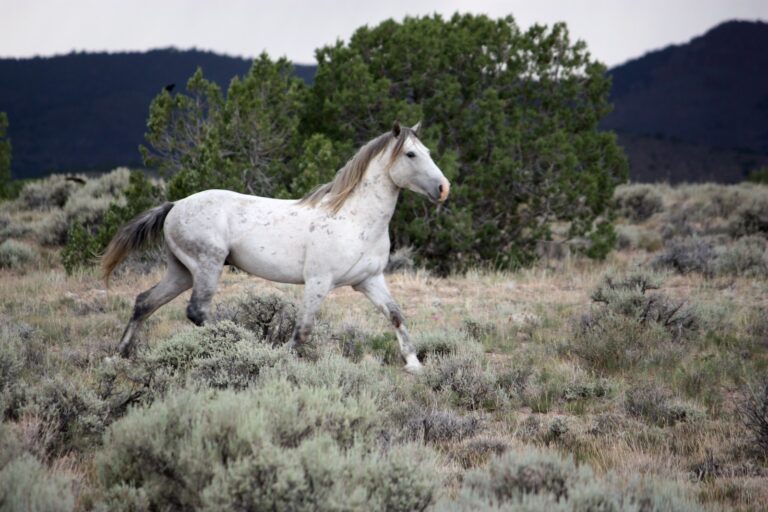
Horses are large prey animals with highly developed responses to perceived threats. The Forest Service’s own Equestrian Design Guidebook for Trails, Trailheads, and Campgrounds explains that a startled horse may balk, spin, jump or run, and that a horse attempting to protect itself may kick, bite or strike. Training and experience can reduce these reactions, but there can be circumstances in which instinct overrides conditioning. And that’s an important distinction.
A well-trained trail horse is not necessarily a horse that will never react. Nor does an unexpected reaction mean that the horse is dangerous or poorly trained. The relevant question in trail planning is whether trail conditions give the horse, rider and approaching trail user enough time and space to recognize one another and respond safely.
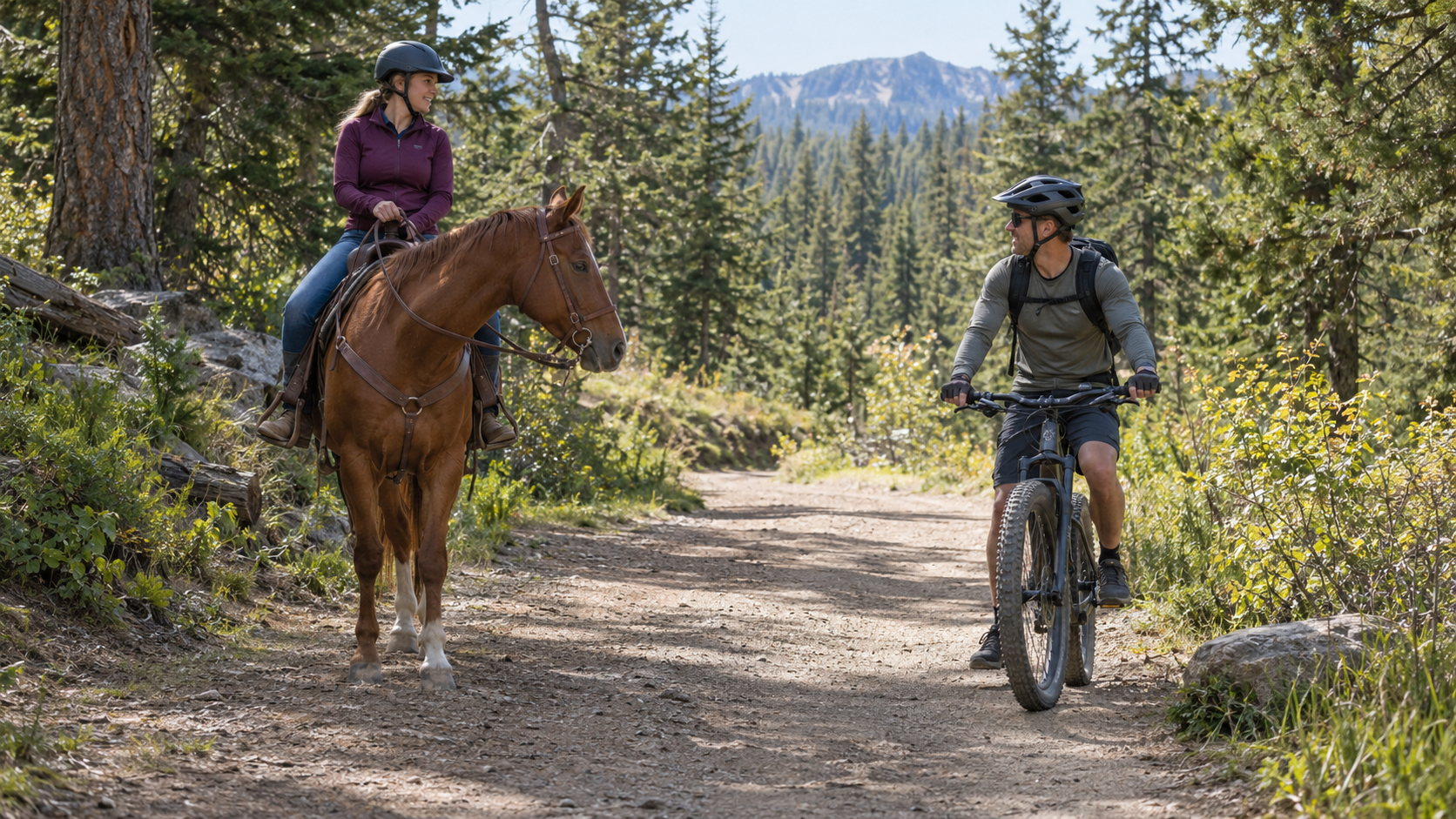
On a broad forest road with long sight distances, a cyclist may be visible for many seconds before reaching a horse. The cyclist can slow. The rider can position the horse appropriately. Both can communicate.
Now change the setting and put the same horse and bicycle on narrow singletrack cut into a hillside. Add heavy vegetation, a blind switchback and a drop-off beside the trail. Let the bicycle approach quietly from behind.
The biological characteristics of the horse have not changed; the margin for error has.
The Cyclist Can Be the One Who Gets Hurt
This is sometimes described as an equestrian safety issue, but that’s not the whole story. The person on the bicycle may be in just as much danger.
A 2015 Australian court case, Daniels v. Boardman, arose after a cyclist riding on a shared-use path was kicked by a horse. The cyclist and a companion had slowed as they approached a group of horses and were traveling at approximately 7 kilometers per hour when the incident occurred. The cyclist nevertheless came within roughly two meters of the horse before being kicked.
The court found negligence on the part of the horse’s rider because he had allowed the horse to move within kicking distance of the bicycle path without adequately checking for cyclists approaching from behind. But the court also found the cyclist 30 percent responsible for her own injuries. The reason is important.
The court concluded that a reasonable person should recognize the danger of entering kicking range behind a horse and should slow or stop if necessary until it is safe to pass. It specifically recognized the increased risk of startling a horse when approaching from behind.
In other words, safe shared-trail use is a two-sided responsibility.
The equestrian has a responsibility to manage the horse and avoid unnecessarily placing other users within danger.
The cyclist has a responsibility not to enter the danger zone until the horse and rider are aware of the bicycle and there is enough room to pass safely.
Cyclists Already Recognize This
None of this requires treating mountain bikers as irresponsible trail users. In fact, the International Mountain Bicycling Association’s own guidance says essentially the same thing. IMBA tells riders to stay in control, anticipate other trail users around blind corners, yield to horses and other nonmotorized users, announce their approach and use special care when passing horses. Its current guidance advises mountain bikers to assume that a child or horse may be around a blind bend and notes that speed and inattentiveness are major sources of trail conflict.
The National Park Service gives similar advice: slow to walking speed or stop when necessary, establish communication before passing and give animals enough room and time to adjust to an approaching bicycle. These rules are not a statement that horses are more entitled to public trails than bicycles. They reflect a difference in controllability. A bicycle responds directly to its rider’s hands and brakes, whereas a horse has a nervous system and thoughts and instincts of its own.
Where E-Bike Horse Trail Safety Enters the Discussion
The distinction has become more important because the Forest Service is considering a substantial revision of its Travel Management Rule. The existing rule generally requires National Forest roads, trails and areas to be affirmatively designated for public motor-vehicle use. It also establishes criteria, public-input requirements and environmental considerations for those designations.
The Forest Service is now considering a different national framework under which existing roads, trails, trailheads and other access points would carry a presumption of being open to appropriate public use unless restrictions are justified by law or by documented concerns involving such things as resource conditions, public safety, conflicts among users or maintenance capacity.
Importantly, that proposal would guide future decisions. It would not automatically open every currently closed trail. Existing motor-vehicle designations and maps would remain in effect until changed under the revised regulations.
The proposal also raises a particularly relevant question for shared trails. Under the proposed action, Class 1 electric bicycles would be exempted from the motor-vehicle-use designation requirement when used on a National Forest trail where conventional bicycles are allowed, subject to land-management direction and other applicable restrictions. The Forest Service has said that the Environmental Impact Statement will also examine alternatives, including continuing to treat Class 1 e-bikes as motor vehicles requiring specific designation.
That does not make an e-bike inherently dangerous to horses. A conventional mountain bike can frighten a horse. So can a hiker suddenly appearing from behind a tree, a loose dog, a motorcycle, wildlife or a plastic bag blowing across the trail.
The relevant questions are more specific:
How fast can one user approach another?
How much warning does each have?
How far can they see?
Is there room to stop?
Is there room to move safely off the trail?
Can the users communicate before one comes within kicking distance?
And what happens if the horse moves several feet sideways?
Those questions can have very different answers on different trails.
Why Site-Specific Trail Design Matters
Consider two hypothetical Forest Service trails.
Trail A is twelve feet wide with long sight distances and frequent places to pass. Horses, hikers, bicycles and e-bikes may encounter one another with ample warning.
Trail B is narrow singletrack on a steep sidehill. Vegetation blocks sight lines. Several turns are blind. There are few places to step off the trail.
The vehicles, horses, and riders may be identical, but the risk is not.
This is why trail-user conflicts cannot always be reduced to arguments over who should have access. Trail geometry, sight distance, speed, traffic density and the physical characteristics of the users are part of the safety equation.
The Forest Service itself has identified public safety and conflicts among uses as factors relevant to the travel-management revisions now being considered. It is also specifically asking the public for information, studies and analysis concerning potential effects of the proposed changes.
This Is Currently Open for Public Comment
The proposal, with link is:
Travel Management; National Forest System Lands
Docket No. FS-2026-0100
The Forest Service’s current comment period closes September 23, 2026.
Comments can be submitted electronically through the federal Regulations.gov portal. Search for:
FS-2026-0100
The Forest Service says comments should clearly explain the commenter’s concerns, supporting information and any recommendations. It specifically invites information about potential alternatives and effects, including relevant studies or analyses. Comments and personal information included in them may be posted publicly, so commenters should not include information they consider private.
This is an opportunity for people who actuallye-bike horse trail safety use National Forest roads and trails to contribute information that may not be obvious from an office or a map.
Equestrians can describe what happens when a horse is approached from behind on narrow singletrack.
Cyclists can describe trails where shared use works well and the practices that make it work.
E-bike riders can explain how Class 1 bikes are actually being used on different terrain.
Hikers, motorized recreationists, trail-maintenance volunteers and land managers can contribute their own observations.
A useful comment does not have to be long, and it does not have to repeat an organization’s form letter. A specific observation about trail width, sight distance, passing space, speed, user behavior or a real incident may be more useful than several paragraphs of generalized opinion. If you have personal experience with horses, bicycles, e-bikes or other users sharing National Forest trails, this is an opportunity to put that experience into the public record.
Shared Use Requires More Than Sharing a Map
Multiple-use trails succeed when the physical trail and the people using it give one another enough margin for mistakes. Most horse-and-bicycle encounters end uneventfully. Many horses become quite accustomed to bicycles, and responsible cyclists routinely slow, speak to riders and pass without incident.
But risk management is not based solely on what happens most of the time. It also considers what can happen when circumstances go wrong, how serious the resulting harm may be, and whether reasonable design or management decisions can reduce that risk. A bicycle rider who comes unexpectedly within kicking range of a frightened horse can be catastrophically injured. A horse startled on a narrow trail can injure itself, its rider or another trail user. And occasionally, as the death of Pops in Massachusetts demonstrates, an encounter that lasts only seconds can have permanent consequences.
That is why the current Forest Service discussion deserves attention from everyone who shares public trails. Not because one group belongs there more than another, but because good trail management begins by acknowledging what each user actually brings onto the trail, including four hooves, two wheels and the laws of physics.